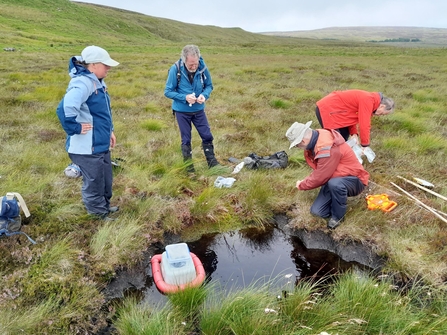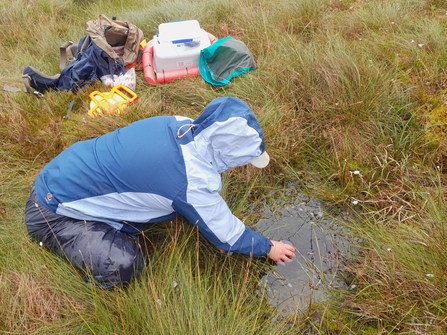


Bog pool © Gautier Nicoli
UPDATE
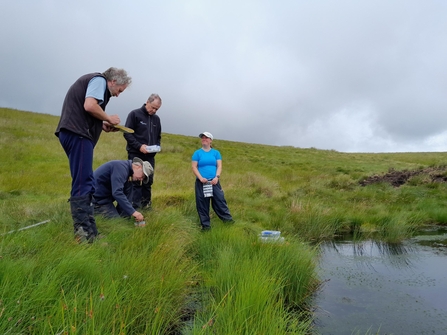
Over the last 10 months, Yorkshire Peat Partnership volunteers, working in collaboration with researchers from the University of Leeds, have been collecting monthly water and gas samples from two restored peatland sites in the Yorkshire Dales. Samples are taken from surface pools, including both naturally occurring pools and those created during peatland restoration.
The two sites differ in the length of time since restoration, providing an opportunity to explore how restoration age influences peatland function.
Results reveal a clear seasonal pattern in carbon concentrations within the water at both sites. Carbon levels are highest during the summer and autumn months and lowest during winter.

Monitoring bog pools © Gautier Nicoli
UPDATE (cont.)
At the older restoration site, carbon concentrations are similar in natural and restoration-created pools throughout the year, suggesting that the restoration pools are functioning in a similar way to natural pools. In contrast, restoration pools at the younger site show greater variability and stronger seasonal responses, indicating that these systems are still developing and have not yet reached the same level of stability.
Preliminary greenhouse gas measurements show a similar pattern, with larger differences between natural and restored pools at the younger site than at the older site.
Overall, these early findings suggest that the age of restoration is an important factor in peatland function. The results provide encouraging evidence that, given time, restored peatland pools can recover and become increasingly similar to natural systems, highlighting the long-term benefits of peatland restoration.