As part of our ACE Bogs project held at Nethergill, 6 artists were invited to develop their own workshops to help local community groups express what peatlands mean to them. One of the project aims was to explore the possibilities that community engagement provides, for increasing environmental literacy, nature connection and reducing feelings of exclusion or intimidation in remote spaces. With 3.5 years in YPP’s Research and Evidence Team, my experience of peatlands is often the same from day to day. I arrive at site, tasked with collecting monitoring data, and I’m only looking for those different devices scattered across the landscape. Water level loggers, rain gauges, peat depth rods, camera traps, sediment traps – tech which tell us something about the peatland which we wouldn’t otherwise know; a tunnel-visioned, technological approach to interacting with the landscape. With six new pairs of eyes on the ACE Bogs project, the peatland at Nethergill was about to be seen through a variety of new perspectives.
Telling stories slowly...

Slow Storytelling workshop at Nethergill Farm © Sara Spillett
Step in Charlie Whinney, an artist whose workshop was focussed on exploring peat in time and space. His initial plan was to design a measuring tool, which visualises how the age of peat changes with depth. This was inspired by the fact that peat accumulates at an average rate of 1mm/year on a healthy bog. After a visit to Fleet Moss with the Yorkshire Dales Millennium Trust’s Youth Environment Forum, his plan began to take form. As the young people danced and played through the landscape, the ground followed suit, mimicking their movements. Rippling moss and wave-like bog wobbles which dispersed with each step generated a motion so mesmerizing and symbolic to this wet environment, that it required further investigation.

Charlie Whinney workshop at Nethergill © Millie German
Charlie’s artwork comprised of 3 pole-like apparatus, which use different methods to measure human-induced movement on the bog:
- The Pendulum – The pendulum holds a paint brush over a piece of paper, so that as the bog wobbles, an abstract-looking picture is created.
- The Laser Line – The laser line shines onto an adjacent pole, so that as the bog wobbles, the movement is captured.
- The Vibration – The vibration app is loaded onto a smartphone, so that as the bog wobbles, the vibrations are recorded on graphs.

Slow Storytelling - Charlie Whinney © Sheryl Zhang
Each apparatus gives us an entirely new way of understanding the landscape. What would the bog wobble tell us? What would a larger wobble indicate? Would the pictures create a pattern? Sometimes, the best type of research is where you ask few questions to begin with and go into it with an open mind. As we tried and tested the different apparatus, new hypotheses started to emerge. Perhaps a larger wobble is a sign of a healthier bog? Maybe this is because there is more water stored in the landscape? We started our monitoring at the fringes of the bog, and worked our way up to the top. As the water table rose closer to the surface, it seemed like the bog was actually wobbling less. Perhaps a higher water table is what causes the bog to wobble less? Maybe this is because the movement is dispersed over a wider area? Can the bog wobble indicate whether a peatland is healthy, or can it tell us something different? Everyone brought their own ideas to the table, discussing the plausibility of each theory, and the evidence at hand. An emerging area of research that’ll likely require further bog wobbling to determine the results of our findings. One of the kids sat wisely in his plump star moss armchair. “I’d lie on the peat all day if I could, it’s a good place for conversations”, he said. I think he’s completely right.

Slow Storytelling - Charlie Whinney © Sheryl Zhang
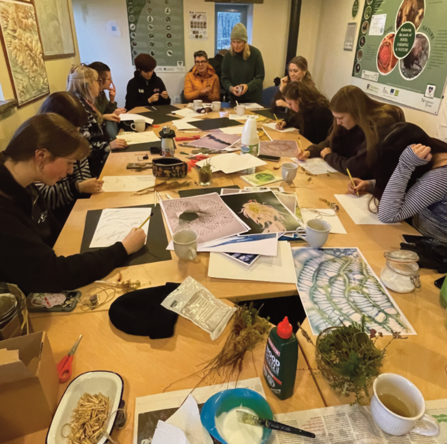
I also had the privilege of attending Sian Atkinson’s workshop with the Keighley Healthy Living (Art 4 All) Group. Her concept came from recognising how peatlands are a place of restoration, memory and holding. The participants were given their own journal and drawing pack, before being guided through a series of exercises. This involved a mindfulness session, and sensory experimentation with natural materials. In the centre of the table sat a collection of watercolour pens, paints, clay, chalk, and foraged materials from the bog at Nethergill. As the workshop began, the barn was fragrant with sweet and earthy smells – a combination of cranberries, clay and a great deal of Yorkshire Tea (a workshop necessity). It was a delight to see the different techniques and designs that emerge when you create an uninterrupted, safe, creative space for a community group. A single piece of moss could incite a realistic drawing, a repeating pattern, abstract art, or a new, natural pigment.
Often the hands will solve a mystery that the intellect has struggled with in vain
This is the quote that Sian used to introduce the final part of the workshop, which involved working with air-dry clay – a first for many of the participants. I helped to divvy up the clay and distributed it around the room, accompanied by Tupperware containing wooden tools and biscuits. We were tasked with creating our own ‘vessel’ with the view to inspire a collective sculpture reproduced by Sian. The great thing about clay is that you can change direction and tear a piece apart to build it back up again, whenever inspiration strikes. I must have changed what I made three times before I settled on the idea of creating little pinch pots to represent peatland pools. There were large vessels with rippled edges, smaller ones with deliberately smoothed edges; miniature versions of the boggy terrain, and vessels inside of vessels to symbolise ‘peaty pockets’. Having seen the final piece displayed in Nethergill Barn, it was very exciting to see everyone’s personality shining through different elements of the Vessel.
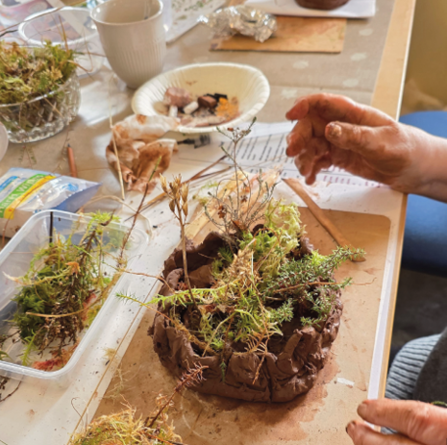
Sian Atkinson workshop at Nethergill
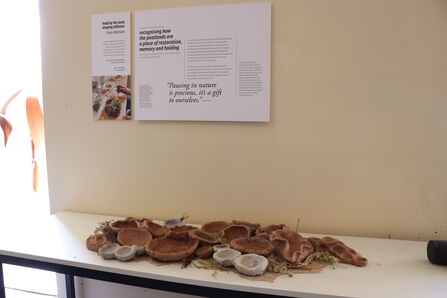
Art from a Sian Atkinson workshop © Sheryl Zhang
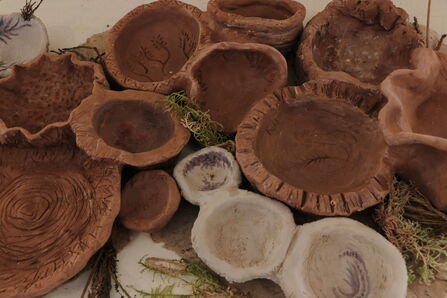
Sian Atkinson workshop © Sheryl Zhang
This was just two of the six workshops that took place as part of the Nethergill FiPL project. Here is a brief look into some of the fantastic artworks that were also created:
- ‘In Slow Tempo’ by Juliet Gutch – three-dimensional forms created from laminated, sustainably sourced sapele veneer. Shapes inspired by experiences of the bog from Ilkley Grammar School.
- ‘Outcomes from the Peaty Dales Way Leaflet’ by Charlotte Wilkinson – working with members of the Dales Way Association, Walkers are Welcome Burley and Friends of the Dales. A celebration of our peaty landscapes along the Dales Way, and collagraphy inspired by the textures of the bog’s microscopic world.
- ‘Seeing Nethergill with Fresh Eyes’ by Ali Foxon – green sketching carried out with Sustainable Swaledale to explore the tiny boggy wonders beneath our feet.
- Adrian Riley – a box of 17 wood tiles each engraved with a glyph and three potential meanings as part of a visual ‘language of the bog’. Developed with asylum seekers and young people from Seacroft, Leeds. Assisted by Chapel FM.
Juliet Gutch workshop at Nethergill © Juliet Gutch
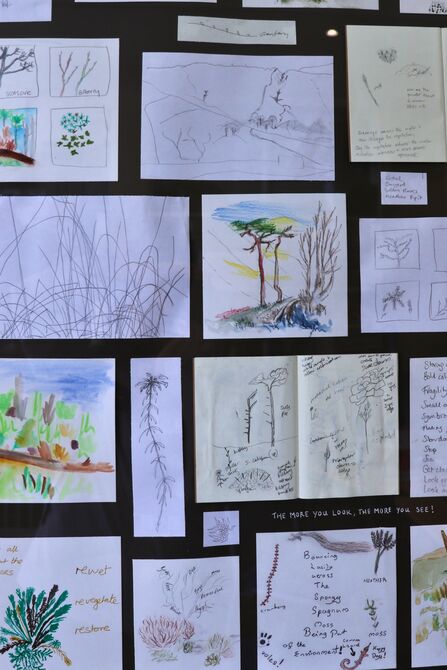
Artwork from Ali Foxon's workshops © Sheryl Zhang

Slow Storytelling - Charlotte Wilkinson workshop © Charlotte Wilkinson

Slow storytelling - Adrian Riley
It takes a collection of minds to identify, interact with, and interpret everything that peatlands have to offer. To look at this landscape through a singular lens - for its climatic importance, its beauty, its cultural ties OR for its archaeological significance - is to obscure so much of the value that it provides. It’s the interplay between each of these things that make peatlands so special. That is the never-ending beauty of bringing the arts into our conservation work. There is always a new way of experiencing peatlands, and there are always new people who see these landscapes in a different way.
The exhibition is at Nethergill Farm until 26th October 2026. You can see more of the artwork and hear interviews with each of the artists on the Slow Storytelling exhibition page.
Opening Hours: The barn is typically open daily during daylight hours, but as opening times can vary, we recommend checking ahead.
How to visit?
Arriving on foot – Booking is not necessary.
Arriving by car – Parking is limited. If you would like to arrive by car, please get in touch with the owners ahead of your visit to arrange.
How to get in contact?
Get in touch with the owners, Malcom and Helen, through their contact page.