Fighting fire with water? What the UK Wildfire Conference didn't talk about...

Fighting fire with water? What the UK Wildfire Conference didn't talk about...

Polytrichum and heather in the wake of a fire © Jenny Sharman

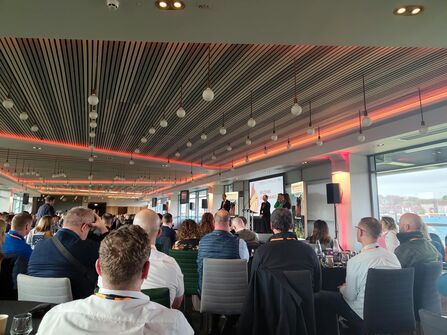
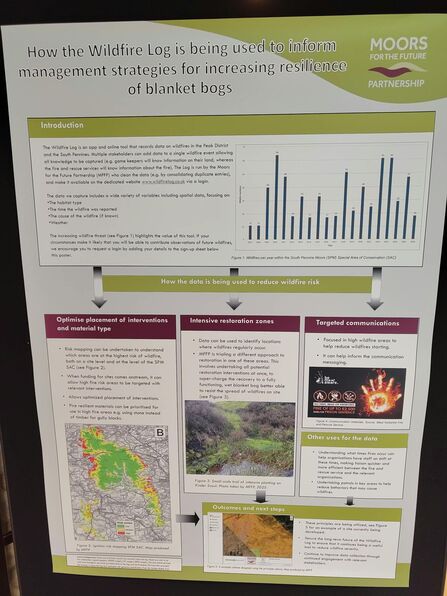
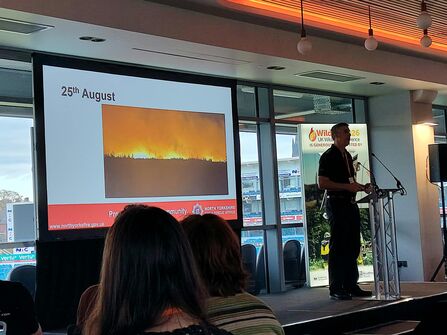
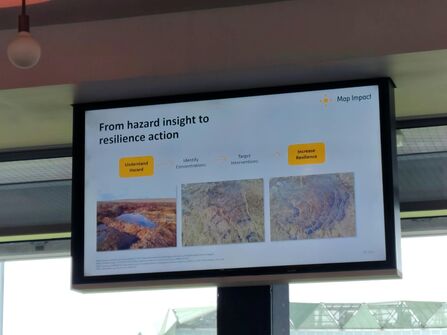
Last week I joined hundreds of fire officers, researchers, insurers, planners and land managers at Wildfire 2026, the UK's wildfire conference. It was packed and genuinely important. It also left me with one nagging question: where was water?

The big picture: fire is rising

The opening message was stark. Wildfire is increasing worldwide, and climate change has reportedly at least doubled the risk of fire. The 2025 to 2026 season produced exceptional fire emissions, with millions of people exposed to smoke and flames, and speakers described fire regimes that are becoming more volatile as well as more intense. 

Closer to home, the picture was just as sobering. The UK's response was described as resting largely on fire services, volunteers and goodwill, with too few people, too little UK-specific evidence and limited tools to support decisions. The Fylingdales fire alone kept crews busy for around six months.  

A fire engine stopped on a moortop road as fire officers attend a moorland fire. Smoke is billowing across the road.

Ogden Moor fire © Ceri Katz

What the conference did well

Credit where it is due: the conference was strong on the human side of wildfire and on practical readiness. Communities were rightly at the centre of the discussion. Experience from the Alps and Portugal showed how much resilience depends on trust, honest communication and local knowledge, and how traumatic a major fire can be for residents and responders alike. The consistent message was to engage communities in decisions rather than simply educate them. 

The science was equally impressive. New work on live fuel moisture and on the volatility of fire regimes is helping to explain why, and when, fires behave as they do and may eventually support more reliable warnings of dangerous conditions. 

Planning and protection also received serious attention. There are currently no wildfire-specific building standards in the UK, and speakers made a strong case for wildfire management zones, separation distances around buildings and evacuation planning built into the planning system. Insurers, meanwhile, are waking up to wildfire, which could bring new money and fresh urgency to prevention as well as to recovery. 

The missing piece

I was struck that nearly every session was about what to do when the fire arrives: detect it, model it, fight it, insure against it, evacuate from it. All vital. But very little was said about why the land burns so readily in the first place. Rewetting and restoration came up only occasionally, and rarely got more than a passing mention. Infrastructure, in most talks, meant buildings, utilities and industrial sites. Peatland, which stores both carbon and water, was seldom seen as infrastructure at all. 

The same pattern appeared in the discussion of water. Summer shortages for firefighting were raised, but the idea that landscapes could be managed to hold more water was not.  

Emergency response will always be needed, and the people delivering it deserve every bit of support. But preparedness without prevention is like mopping the floor while the tap is still running. 

EU LIFE Programme monitor inspecting restoration works at Fleet Moss

Fleet Moss restoration © Jenny Sharman

What the evidence says

There were bright spots, and the clearest came from research presented by the RSPB. It described a gradient of peatland condition that links how wet a site is to how it behaves in a fire. 

Degraded peat, with a low water table, has high wildfire potential, and the two reinforce one another in a vicious circle. Transitional peat holds more water and is less likely to burn, but vegetation and hydrology take time to catch up with rewetting, so its response to fire is no longer straightforward. Near-natural peat, with a high-water table, carries lower fire risk. 

We also heard a National Trust example in which rewetting reportedly stopped repeated burning on a site, and the new pond gave firefighters water close to hand. Restoration reduced the fire risk and helped the response in a single move. 

Moorland on which rewetted peatland has been untouched by wildfire while the surrounding land is scorched

Rewetted peatland resilient to wildfire © Elan Valley Trust

Why this matters to us

Peatlands are water stores, carbon stores and wildlife havens. Nature is not a nice-to-have, it’s a necessity and peat is a vital component in its infrastructure. Wetter, healthier peat is a stronger buffer against fire, and every hectare restored is a hectare less likely to need rescuing later.  

This year has started to provide real-world evidence. When a wildfire tore through the Elan Valley, with its 12 SSSIs, in Wales at the end of April, burning around 8,000 hectares in seven days, drone footage showed a sharp line between blackened ground and an area of pools and green peat that the fire did not touch. Rewetting there had begun only about 18 months earlier. It is not a magic bullet, since some of the affected land had no peat and flammable purple moor grass remains a fuel problem, but it is a striking illustration of how wet ground can stall a fire. 

North Yorkshire’s moors have been fortunate not to suffer many major wildfires, with Fylingdales and Langdale the notable exceptions, so most of the best-documented examples come from elsewhere. Even so, our own observations point the same way. When we surveyed Fylingdales after the fire, the areas that had burnt least were in the wetter parts of the moor, where bog pools and a diverse vegetation cover were present. 

Fieldwork during this summer's heatwave told a similar story. While surveying in the Dales, we found Sphagnum hummocks that looked bleached and dry at the surface but were very wet, and noticeably cooler, inside. Even at the height of the heat, they were maintaining a wet and cool microclimate. These are field observations rather than controlled measurements, but they suggest that healthy Sphagnum can protect itself, and the peat beneath it, long after the surface has stopped looking green.  

Structure matters as well as wetness. A patchwork of fuels tends to break fire up, whereas uniform, fine fuels let it run. Restoration that rebuilds a wet and varied mosaic may therefore be doing double duty, for biodiversity and for fire resilience. 

The science is still developing, and there is genuine debate about rotational-burning, cutting, grazing and rewetting, including how quickly vegetation responds after rewetting. That is exactly why long-term monitoring matters: good data from restored sites can help to establish the case.

Heather stalks stripped of their foliage and Polytrichum moss turned orange in the wake of a fire

Polytrichum and heather in the wake of a fire © Jenny Sharman

Where next?

The conference showed a motivated and committed community, and our job is to make sure peatland restoration has a seat at the table. In practice, that means sharing evidence from our restoration sites, talking to fire services, landowners and researchers, and helping to make the case that healthy, wet peat is part of the wildfire solution. 

Crucially, we are committed to keep gathering the data that fills this evidence gap. Yorkshire Peat Partnership is currently putting together a four-year monitoring report, funded through Defra's Nature for Climate scheme, which will set out the benefits of restoration across the full range of ecological and infrastructure services that a healthy peatland provides. We will use it as a springboard to expand our monitoring capability and to target specific questions, with wildfire resilience a natural candidate. 

If you work on wildfire, land management or restoration and would like to talk, we'd love to hear from you. 

Contact us